Recently the Rippling CPO's podcast episode was passed around my team at work. Matt MacInnis - wickedly intense, a bit spicy - made arguments that both resonated with folks and made us uncomfortable. I wanted to write down the takeaways that struck me.
The core thesis is simple:
"If you want to be in the 99th percentile in terms of outcomes, it's going to be really difficult. It's going to be really uncomfortable. And you got to sort of remind people of that - that if they ever find themselves in the comfort zone at work, they are definitely making a mistake."
Intensity drops off in concentric circles
Listening to Matt, you immediately hear that he's an intense person. He makes an argument that companies need the central leader to be the most intense, urgent, and obsessed person in the business. Each layer of management under that center node experiences a falloff.
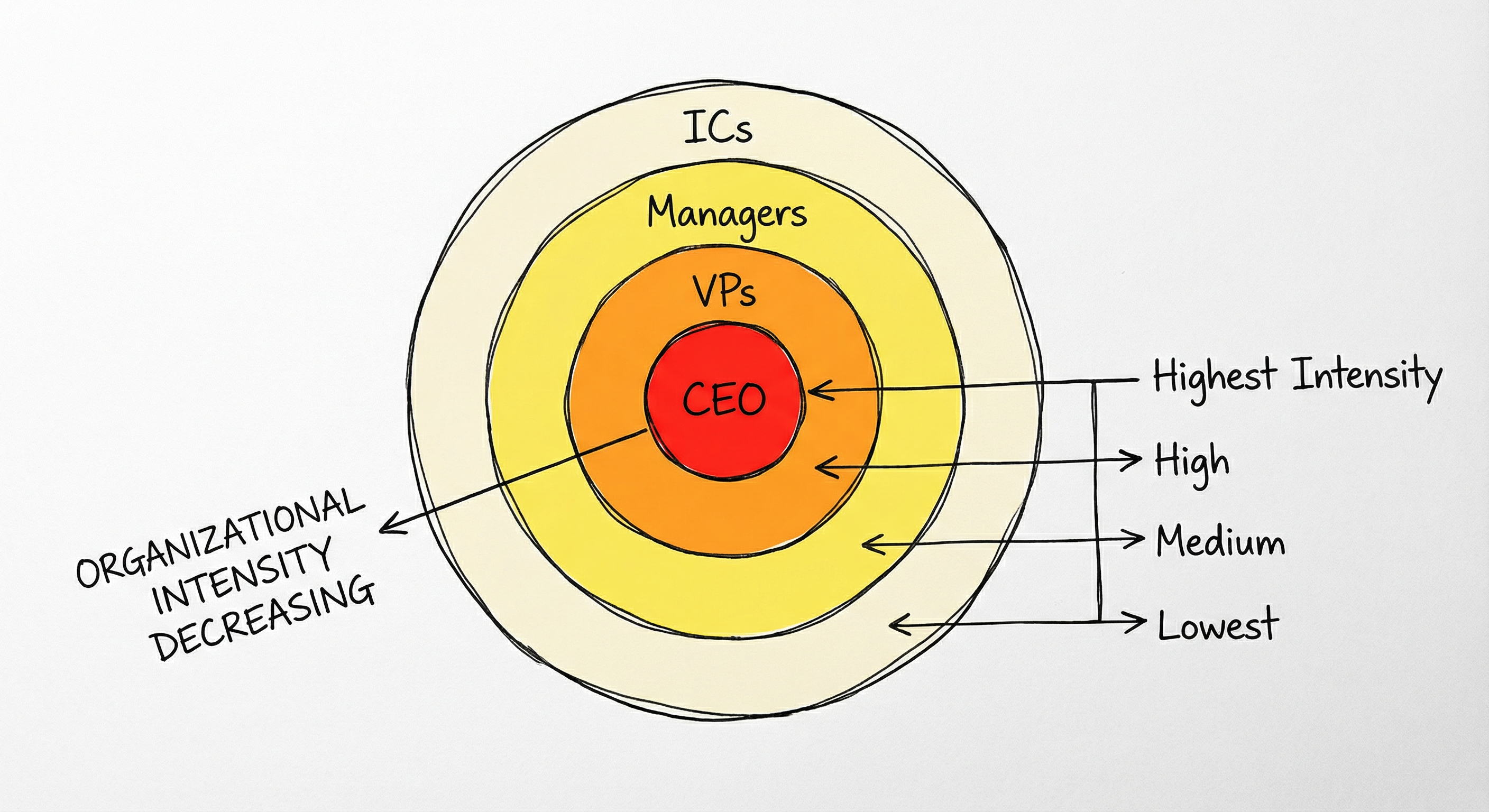
The founder CEO will work seven days a week, hound people, and feel like they'll die if they're not successful. Their reporting managers will push very hard, work late nights on weekdays, and do their best to succeed. Those managers' reports will work hard while living balanced lives, and would generally like the company to be successful.
Each layer drops off a notch. Matt puts it starkly:
"The purest form of ambition and most intense source of energy in the business is the founder CEO. Every next concentric circle of management beyond the founder CEO has the potential to be an order of magnitude drop off in intensity. That is fucking dangerous."
Why the dropoff? For one, the founder CEO usually has perfect incentives. They're root responsible for costs, failures, and also most of the upside of success. Middle managers have some skin in the game, but less - and aren't responsible for all failures. By the time you get to ICs, you start finding people who both want to do a good job intrinsically, but also might be extractive and unresponsive to any large failures.
Second reason: it's uncomfortable holding others to an intense bar. Managers need to set the constants for others and challenge them to be uncomfortable. Parents do this. Sports coaches do this. And managers do this. It's uncomfortable making other people uncomfortable - unless you're a sociopath. So in reality, many managers do a partial job. When asked for their org to move mountains, they pass the message down but dilute it with empathy and care. They dilute it nonetheless. It's human, but results in compounding falloff.
Mirror intensity, don't buffer it
What's the winning move? Every member of a company should mirror the intensity, urgency, and obsession of their leader downward. Even better if you can amplify it, but at the very least mirror it.
"There are plenty of constituents in the business around you who will advocate for relaxing. There is an infinite supply of people under you who will buffer other team members from the intensity of the demands. Your job is not to be one of those buffers. Your job is to preserve that intensity at its highest possible level and let the buffering happen somewhere else."
If you're a leader and manager, there's almost no upper bound in how die-hard, meme-ishly passionate and obsessive you can be. Not because it itself is maximally efficient and healthy, but because you know you're role-modeling the bar that others will follow with some dilution. Accounting for the dilution, you need to go overboard as a leader.
You can do all of this without being harsh, crass, or mean. You can still be kind, charismatic, and friendly. In my head, I imagine the best sports coaches - demanding and intense, but also beloved. Matt's framing on chill bosses sticks with me:
"Nobody in a position of leadership wants to be chill. And what's worse than a chill boss? Don't work for a chill boss. Don't be a chill boss. It's the most pejorative label I could give you. Chill doesn't accomplish shit. Be intense. Be good, be respectful, be intense. Don't be chill."
It's all a game
In a vacuum, it's easy to hear this philosophy and mark it up as toxic hustle porn. How can you sleep at night knowing you're pushing so many other people into a zone of discomfort? Why are you maximizing shareholder value so hard?
Matt calls this out in the podcast. The reality is everyone in tech is paid plenty well enough. To lead people into a zone of discomfort, you have to do it for the love of the game.
"At the end of the day, business is a game and none of this matters. We're not going to carry it to the grave. You're here to do this stuff because it somehow fulfills you while you're on the planet."
Excellent management approaches that of a sports game - it doesn't matter when your soul is judged in heaven or when your parents are on their deathbed. But it certainly is a fun craft and sport worthy of attempting to be the best at. And with the right mindset, people want to be pushed. They want to work hard and do amazing things. Players on a sports team are constantly uncomfortable and out of breath. But they love it - they're passionate and want to flex their abilities and see what's possible.
Intensity and obsession isn't a bad thing to push onto the people you lead. You have to view it as a positive and beautiful thing.
Free will matters here. Folks should always have the option to opt out, quit, find a new job. Luckily this is always true in tech - there's not one person who's quit or been fired at my company who hasn't immediately found great new work. Everyone is paid well, and no one is going to the street.
And like sports, no one should be challenged to the point that it's critically unhealthy. It's a game, and not worth pushing people into depression, self-harm, or missing their family member's wedding. Play the game maximally, but remember it's still less important than key aspects of life.
I find these ideas together quite freeing. High performing teams want to be pushed. It's all a game and doesn't really matter. So why not adopt a maximally intense, obsessed, urgent mindset as a leader? Try your hardest, and challenge everyone around you to try their hardest. Act with kindness, speak with empathy, and yet still be demanding of greatness.
When this approach works
There's a catch. This philosophy only works under certain conditions.
First, you need to be winning - or at least have a real shot at it. I created Graphite, and now work at Cursor. There were points at Graphite where we challenged engineering teams to work weekends and code their best quality work, all while very few users were adopting the product. We had failed launches and early pivots. It's like being a member of a struggling sports team - why train unbelievably hard when the results just aren't there?
Matt makes this point directly:
"Extraordinary outcomes demand extraordinary efforts, but if there's no chance at an extraordinary outcome, it's very hard to get the extraordinary effort. It's so rare to have the opportunity to be a part of a team where the extraordinary effort that you do put in is actually contributing to an extraordinary result."
On the other hand, taking the same team and joining Cursor, it's obvious how much more rewarding it is to work maximally intensely. The work matters. The code ships to literally millions. The outcome might be the best work of everyone's careers - if only they try their hardest.
Second, the team needs to believe in the direction. If you demand the team builds a billing system they think is destined to fail, or you demand they sprint on a project that will surely get killed later, folks will struggle to accept your demanding push. As a leader you still need to build that buy-in and get folks to follow the logic. Otherwise they'll just quit or drag their feet.
The formula isn't just intensity. It's shared conviction plus intensity plus a real shot at winning. Get those three aligned, and you can demand extraordinary effort without burning people out or driving them away.
"Good teams get tired and that's when great teams kick the good teams' asses."
Be willing to pivot or quit if it'll get you onto a more impactful piece of work. It sucks grinding for something that's not working. But that doesn't mean you shouldn't grind - it just means you should focus the grinding toward getting to something that works.